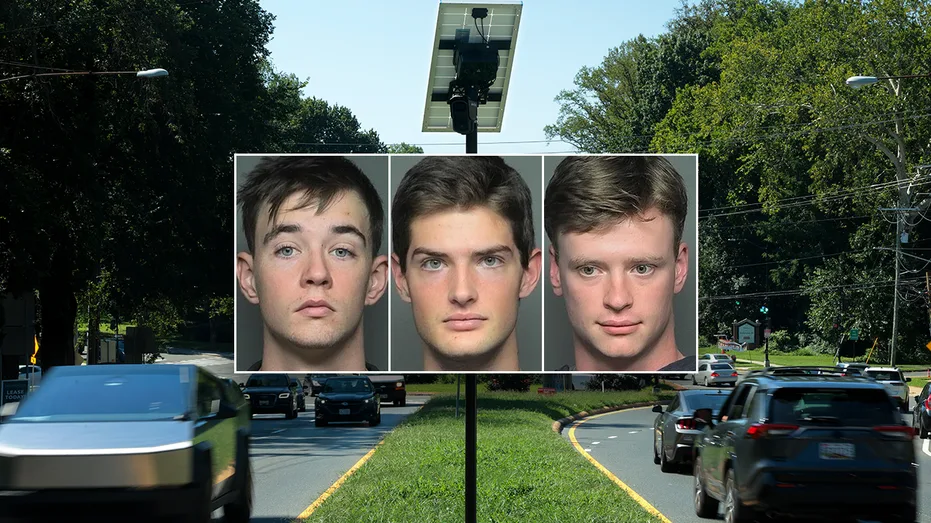
Three teenagers in South Carolina have been taken into custody following allegations they deliberately destroyed a Flock Safety camera pole and repeatedly struck its battery pack with a hammer until it detonated and caught fire, according to law enforcement officials.
The incident reportedly took place in the early morning hours of August 15 on Harmony Church Road, located in the Edgemoor area of Chester County. Investigators stated that the teenagers first cut down the pole before damaging the equipment with a hammer, which then caused the battery to ignite. Authorities estimate the damage at over $5,000.
Records indicate that one of the individuals, identified as Fuller, was booked on August 18 and released the following day after posting a $5,000 bond. Carlisle and Ryerson, the other two accused, were also booked on August 18 and subsequently released on August 19.
A resident living nearby, David Cunupp from Edgemoor, expressed significant concern about the blaze, fearing it could have escalated into a much more serious event.
“My house is over here,” Cunupp remarked, gesturing toward his property. “Could’ve caught fire and burned if it wasn’t for the rain.”
While Cunupp did not explicitly oppose the use of such cameras, he questioned the involvement of a private corporation in managing surveillance technology.
“They could be used for good, but I don’t see where a private company’s got access or running it instead of the DMV or the government,” Cunupp stated.
National Scrutiny Over Surveillance Networks Intensifies
This alleged act of vandalism occurs at a time when tensions are mounting across the nation regarding Flock’s extensive network of automated license plate readers. Privacy advocates, local government officials, and lawmakers are increasingly challenging the proliferation of vehicle location databases.
Critics of these cameras have condemned destructive acts like vandalism, instead advocating for legal and procedural challenges to the technology.
Earlier this week, Senator Josh Hawley (R-Mo.), who chairs the Senate Judiciary Subcommittee on Crime and Counterterrorism, initiated an inquiry into Flock. He asserted that the company has established an “unprecedented national surveillance network,” boasting over 120,000 cameras across 49 states and conducting more than 20 billion vehicle scans each month.
“Instead of serving discrete local investigations, as contemplated by our constitutional processes and safeguards, these camera networks harness artificial intelligence to pool what they capture into a national database that customers can search,” Senator Hawley wrote in a letter addressed to Flock CEO Garrett Langley.
Local Governments Push Back Against Data Collection
The controversy has also played out at the local government level, notably in Texas. Officials in Hood County voted to terminate their agreement with Flock and subsequently ordered the county’s three cameras to be disconnected and covered until their complete removal could be arranged.
Constable John Shirley shared images of the covered cameras in a social media post, hailing it as “a good day for the Freedom of the people of Hood County.” He noted that the cameras had been “constantly scanning and recording regular folks just going about their day.”
“That kind of permanent, warrantless tracking doesn’t belong in a free society,” Shirley wrote. “Privacy isn’t optional, and mass surveillance isn’t how we do things here.”
In a subsequent social media update, Shirley clarified his support for technology that aids law enforcement in solving crimes, locating missing individuals, and apprehending dangerous suspects. However, he emphasized that public safety considerations should not overshadow the discussion of individual liberties.
“We can have good policing and still insist on boundaries,” Shirley asserted. “We can use technology without giving government unlimited surveillance capability.”
The ongoing discourse has already prompted communities in states like Texas and Arizona, as well as many others nationwide, to re-evaluate or discontinue their contracts with Flock, citing concerns over data sharing practices, privacy implications, and potential misuse of the collected information.