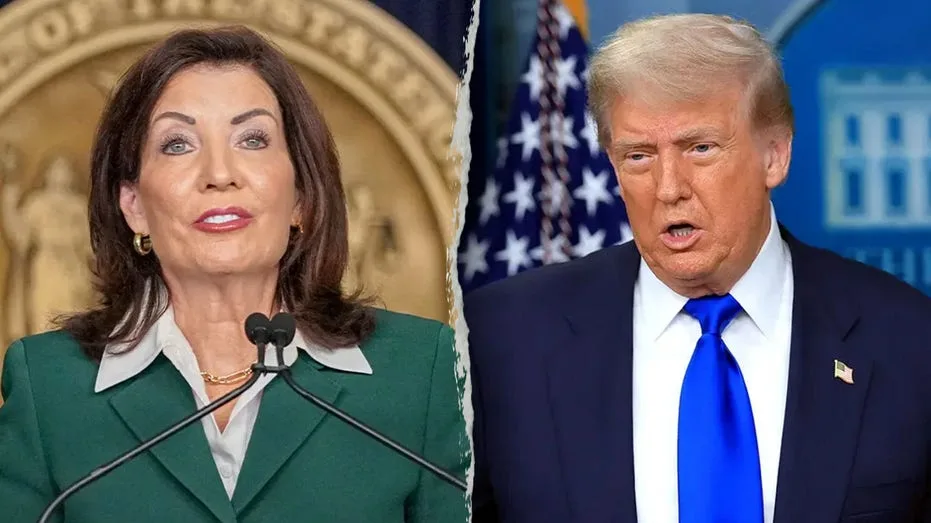
Governor Kathy Hochul of New York announced on Thursday that her state would not recognize President Donald Trump's executive order to rename Lake Ontario as 'Lake America.' The directive was issued amidst an intensifying trade dispute between the United States and Canada.
“New York won’t be calling it that,” Governor Hochul, a Democrat, declared on social media platform X.
The Renaming Controversy and Its Reach
President Trump's executive order mandates that the Interior Department and the Board on Geographic Names update federal records and provide guidance to reflect the new designation for the Great Lake. However, this order does not compel Canada or international organizations to adopt the proposed name change.
Canadian Prime Minister Mark Carney issued a statement emphasizing the historical significance of the lake's current name. “The name Lake Ontario comes from the Wendat word Ontari’io, which, appropriately, means 'the lake is beautiful, the lake is big.' The name is more than 400 years old, predating both the Confederation of Canada and the Declaration of Independence of the United States of America,” Carney stated.
“We know that America is changing. Their trading relationships, their foreign policies, their national monuments, their hydronyms. Canadians also know that naming reality means calling it Lake Ontario — then, now and always,” he added.
U.S. states are also not bound by the federal order and retain the authority to continue using 'Lake Ontario' on their official state maps, highway signage, and tourism promotions. Alongside Governor Hochul, other state leaders, including Wisconsin Governor Tony Evers and Vermont Governor Phil Scott, have openly criticized or mocked the renaming effort.
“And I just renamed Lake Michigan Lake Wisconsin. See, I can sign napkins that say things, too,” Wisconsin Governor Tony Evers, a Democrat, posted on X. His message accompanied a video depicting him writing “Lake Wisconsin” on a McDonald’s paper napkin and then signing it.
Vermont Governor Phil Scott, a Republican, characterized President Trump's decision to rename the lake over the trade disagreement as “petty and disappointing.”
“We should be at the negotiating table, finding a path forward that strengthens both the U.S. and Canadian economies. Further escalating tensions does nothing to help American or Canadian families and businesses,” Scott remarked.
Historical Significance and Economic Impact
The name Lake Ontario is widely understood to derive from an Indigenous term translating to “lake of shining waters.” The lake's watershed supports approximately 5.6 million residents across both the United States and Canada. Lake Ontario forms a shared border with Canada's Ontario province and New York State, serving as a vital link between the Great Lakes and the Atlantic Ocean via the St. Lawrence Seaway, a crucial waterway for commerce.
Governor Hochul has previously voiced criticism regarding the trade dispute with Canada, asserting earlier in the week that the president is “treating our allies as enemies” and that “American families continue to suffer because of it.”
New York is among several states anticipated to experience significant economic repercussions from the trade conflict with its northern neighbor. According to the office of U.S. Trade Representative Jamieson Greer, the total value of goods and services traded between the U.S. and Canada reached an estimated $872.3 billion last year.
Escalating Trade Tensions
Prime Minister Carney confirmed that the Canadian government intends to implement retaliatory tariffs on U.S. goods, effective September 8. This action comes in response to the Trump administration’s new 50% tariffs, which target approximately $20 billion worth of Canadian products and became effective earlier this month.
The prime minister affirmed that Canada “will match Washington's new tariffs dollar for dollar in order to protect Canadian workers, farmers, families, and businesses.”