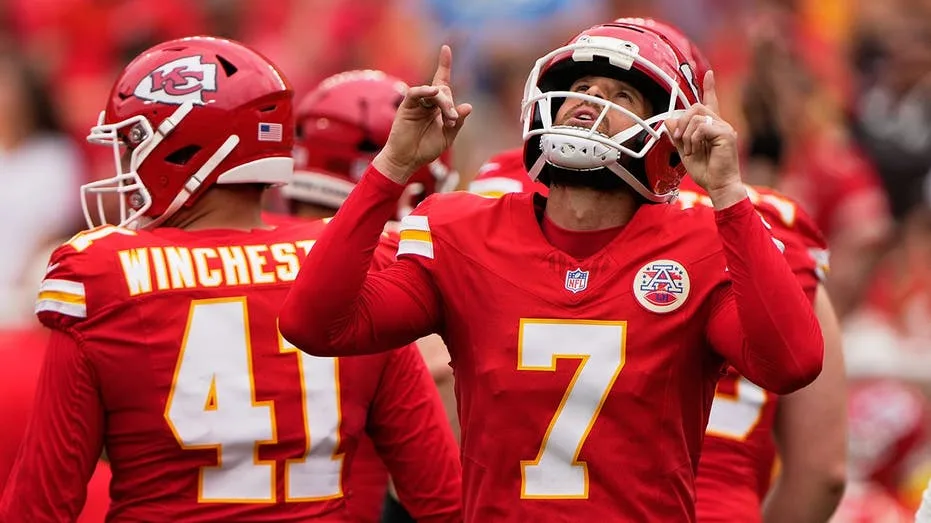
Kansas City Chiefs kicker Harrison Butker, who previously garnered national attention for comments made during a commencement address at a Catholic university, recently demonstrated his formidable leg strength with an extraordinary 69-yard field goal during a preseason matchup. Butker's remarks, which included his perspective on the importance of family life, drew considerable criticism, prompting the NFL to issue a statement clarifying that his views did not represent the league's official stance. Creditably, the Kansas City Chiefs maintained their support for Butker, a decision that has likely been affirmed by his consistent performance.
In the 2025 season, Butker successfully converted 33 out of 38 field goal attempts, with his longest being a 59-yard effort. However, his recent preseason kick against the Tampa Bay Buccaneers suggests this personal best could soon be surpassed. Just before halftime, Butker sent the 69-yard attempt soaring through the uprights, a kick some observers felt could have been good from even further, perhaps 72 yards.
Despite the impressive distance, Butker himself emphasized his focus on accuracy over length, particularly after missing another kick later in the same game. "You've got to make your kicks. Miss an extra point, miss a game-winner. That's what I care about, not the 69-yarder or whatever it was," he stated following the game. He added, "I feel like throughout my career when I've had big kicks, it's been a struggle to finish the game or the next game. I feel like mentally I was good on that 43-yarder. It felt good off my foot. Maybe I need some more caffeine for the second half or something."
The NFL's Pursuit of Increased Scoring
Butker's exceptional kick, while individually remarkable, also highlights a broader trend within the NFL: the increasing ease with which kickers are converting field goals from considerable distances. This development has sparked concerns that the league's product is being diluted by an effort to artificially inflate scoring.
Historically, NFL scoring has experienced periodic fluctuations. A notable dip occurred in 2017, when teams averaged just 21.7 points per game. In response, the league began implementing rule changes designed to favor offensive play, such as a renewed emphasis on calling illegal contact penalties, which commenced in the 2018 season.
These adjustments initially boosted offensive output, but defenses eventually adapted. Consequently, scoring again declined in 2022 and 2023, averaging 21.8 and 21.9 points per game, respectively. This prompted further intervention from the NFL, which introduced additional illegal contact and defenseless receiver rules, alongside the significant implementation of the dynamic kickoff.
Impact of Recent Rule Adjustments
The dynamic kickoff rule has dramatically altered average starting field position, with teams now typically beginning their drives around the 31-yard line. Touchbacks, for instance, now place the ball at the 35-yard line. While the league publicly stated these changes were primarily intended to enhance player safety, an evident secondary benefit was to advance the ball further upfield, thereby increasing scoring opportunities.
Another, less publicized, change involves the preparation of "K-balls"—the specific footballs designated for kicking. Prior to 2025, kickers and equipment staff had only a few minutes before games to handle these balls. However, under the updated procedure, they now have extended opportunities to prepare and, as some suggest, optimize these footballs, removing the rush to make them travel farther on game day.
Expert Reactions and Debates
The impact of these changes has not gone unnoticed by league personnel. Philadelphia Eagles defensive coordinator Vic Fangio commented on the trend after a game in 2025, drawing a parallel to a controversial era in baseball. "You know what you guys have missed? Not just you but everybody is, we gave up a 65-yard field goal and a 58-yard field goal," Fangio told reporters. He continued, "These kicking balls that changed this year, have drastically changed the kicking game, field goals in particular. It's almost like they need an asterisk era, like it was the live ball era, or the asterisk for those home runs that [Barry] Bonds or [Sammy] Sosa or [Mark] McGwire were hitting. The way they have changed the ball, the NFL has drastically changed the field goals."
An anonymous special teams coordinator, speaking to a major sports network about the modifications, offered a perspective that has been met with skepticism. "There may be a little extra distance on the ball. I mean, could you argue that maybe there are a couple, 3, 4 yards extra on every ball? But the odds of making the kick haven't changed one bit, so I don't think it's going to change your game analytics that much."
Critics argue that this assessment is flawed. Adding three or four yards of potential distance to a kick inherently alters the probability of success. Such an increase can be the crucial difference between a successful 60-yard field goal and a miss, or provide the necessary power to keep the ball on its intended trajectory and within the uprights, where less yardage might have resulted in it veering off course.
When kickers like Harrison Butker and Cam Little (who notably made a 70-yarder in 2025) have a realistic chance of converting 70-yard field goals, and the league average starting field position is already at the 31-yard line, the nature of NFL "scoring" drives fundamentally shifts. It becomes conceivable for a team to gain as little as 14 yards on a drive originating from a touchback and still put points on the board, raising questions about the quality of offensive play required for scoring.
Statistical Trends and Future Projections
The statistics from the 2025 season further illustrate the effects of these procedural changes. While the league saw a slight decrease in the total number of field goal attempts from 50+ yards compared to 2024, overall field goal accuracy improved year-over-year. More significantly, the number of successful field goals from 60+ yards, as well as the total attempts from that range, increased substantially.
In 2024, kickers converted just four out of 14 attempts from 60 yards or more. By contrast, in 2025, they were successful on 12 out of 22 attempts from the same distance. The league-wide average field goal attempt yardage also reached an all-time high of 40.5 yards. Projections for 2026 suggest these figures are likely to continue their upward trajectory.
With kickers like Cam Little demonstrating kicks of 67 and 68 yards, and Butker clearly capable of 69-70 yards, coaches are increasingly recognizing the 45-50 yard line as viable field goal territory. This shift will undoubtedly lead to an increase in long-range attempts. While fans may not immediately object to teams scoring points after minimal yardage gains, such scenarios—where a team runs six plays, gains 18 yards, and secures points—are seen by some as detracting from the compelling and exciting nature of professional football.
This aggressive push reflects the NFL's apparent determination to maintain high scoring and prevent a return to eras dominated by defense. The league often introduces significant changes, however unconventional, banking on fan loyalty to sustain engagement. Whether this latest evolution in the kicking game will significantly impact fan perception remains to be seen, though a substantial shift is perhaps unlikely.