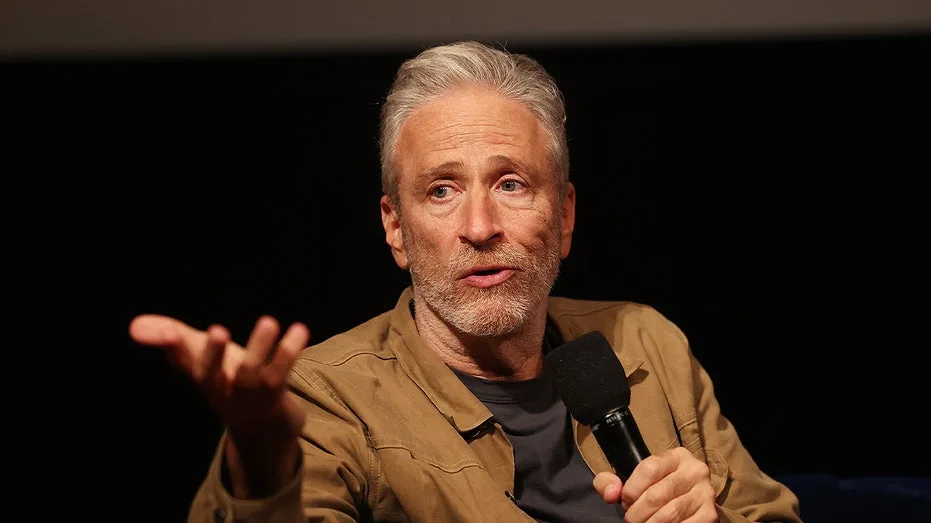
Veteran talk show host Jon Stewart recently engaged in a candid discussion with former First Lady Michelle Obama, expressing his introspection regarding whether programs like his have ultimately served as a net positive or negative influence on the nation's political landscape.
During an episode of Obama's "IMO" podcast, the former First Lady directly asked Stewart about the implications of young audiences primarily receiving their news through satirical outlets such as "The Daily Show."
"Do you think comedy helps or hurts the political climate?" she inquired. "I wonder what you think, because sometimes I think, ‘Is it good that most young people are getting their news from The Daily Show?’ Or that they — you know — they want you to run for president?"
Assessing Comedy's Role in News
Stewart initiated his response by reflecting on the evolving relevance of late-night shows, characterizing them as a "relic" of a bygone era. He drew an analogy to outdated businesses, stating, "We are in some ways a relic of a previous era where it's sort of like I'm running a Blockbuster, a video store inside of a Tower Records." He attributed this shift to the profound impact of social media, noting how even his program has had to adapt to these new platforms to extend its reach. Observers have frequently commented that the traditional late-night talk show format itself appears increasingly superseded by the rise of long-form podcasts and digital content.
The comedian further elaborated that he has learned to distinguish between cultural influence and actual political power. While acknowledging the cathartic role such shows can play, he nonetheless described the format as feeling somewhat "impotent" and potentially acting as a kind of "opiate" for the American populace.
"Is it an opiate?" Stewart questioned. "Is it creating a, you know ... And having worked on some of those things on Capitol Hill and all that, I know the difference now, which I didn't before. The difference between activists who are in the trenches doing that day-to-day work, trying to bend that arc of the moral universe slowly towards justice, not realizing there's a bunch of people trying to bend it back."
The "Political Diabetes" Metaphor
Stewart expressed a curiosity about the findings a rigorous study might yield regarding his work's true impact. "Like, does this help? Does it corrode? Does it pervert?" he mused. He extended this line of questioning with a potent metaphor: "Is it something to be — is it ultra-processed, you know, food that's given the country a kind of political diabetes? I don't know."
He continued by emphasizing the importance of good faith in creative endeavors. "I think I also have to step back on — it may not be an honorable thing we do, but we do it as honorably as we can in that it is not in bad faith," Stewart affirmed. "So, the way that I try and judge it is, any good faith art, material, speech, talk that goes into the universe, I feel like is a win."
Despite this, he acknowledged the prevalence of negative intentions. "There's so much bad faith," he warned. However, he remained hesitant to make definitive claims about his show's broader societal benefit. "But I can't sit here and honestly answer like, ‘It's a win for society. What I've done over these past 25 years,’ you know, I’d hate to think, obviously, but there's many people on social media who would tell me, you know, that that is the case."
A Critic's Perspective
Tim Graham, the executive editor of the NewsBusters division of the Media Research Center, echoed Stewart's concerns regarding the role of comedy in political discourse.
"The concept of Americans getting their 'news' from comedy shows is always a terrifying prospect," Graham stated. "Stewart's right with his metaphor of ultra-processed food. Political comedy's a Twinkie and not a bran muffin. People can have very distorted views on a comedy-alone diet, like thinking Sarah Palin actually said, ‘I can see Russia from my house.’"
Graham further contended that late-night comedy can be likened to an "opiate" for its audience, particularly for those seeking an outlet for their frustration following specific political outcomes. He cited statistics, noting that in 2024, late-night shows dedicated a significant 82% of their political humor to former President Trump and Republican figures.
He also remarked on what he perceived as an irony in the discussion taking forth on the Michelle Obama podcast. "It's a little bit funny that they're discussing partisan hackery on the Michelle Obama podcast," Graham commented. He asserted that the Obamas have historically received exceptionally favorable media coverage in modern American history, suggesting that late-night comedians often do not adhere to the principle, "When they go low, we go high," when it comes to certain political figures.